


CONTEXT
The haor in Bangladesh is characterised by its diversity. For nearly half the year, the haor region remains a vast expanse of deep water, and for the remaining half, it becomes arable farmland. Livelihood opportunities in the haor, therefore, are more limited than in other regions of the country. During the waterlogged period, duck rearing becomes an integral part of the haor’s local livelihood, with many people operating small- and large-scale duck farms in this region.
CHALLENGES
Despite the potential and popularity among locals, large-scale duck farming is difficult in remote haor areas due to a shortage of ducklings. Local hatcheries that produce ducklings are also rare, despite the high demand for ducklings. Consequently, farmers who opt for duck farming are compelled to collect ducklings from distant commercial hatcheries, which increases the price of ducklings and their transportation costs. Often, these ducklings die during the long journey, causing potential duck farmers a significant loss at the outset.
PROJECT INTERVENTION
As an initiative of the PPEPP-EU project, some clusters were formed with farmers producing fertile duck eggs in three Upazilas of the haor region. These clusters, then, received technical support to establish small-scale duck hatcheries as an income-generating activity. The objective of this initiative was to ensure an uninterrupted supply of ducklings to local farmers of the haor region at a fair price by reducing transportation-related risks and costs.
Selina Akhter is one of the successful members of the PPEPP-EU project with a duck farm and a hatchery. She is a PPEPP-EU member who resides at Sadar Union of Itna Upazila in Kishoreganj District. Selina and her husband, Sohrab Hossain, were doing well with their duck farm. Unfortunately, 500 of her ducks died from the “duck plague” in 2023, leaving her with a significant financial loss.
Later that year, Selina attended a training organised by PPEPP-EU on duck rearing and its opportunities. She learned about large-scale duck farming techniques and the importance of establishing a hatchery. With increased knowledge and motivation from the project staff, Selina took a second loan of 100,000 taka from POPI to restart duck rearing and gradually rebuild her duck farm.
RESULTS
Selina’s duck farm produces approximately 450-500 eggs daily, which she sells to local wholesalers at 15 taka per egg. Setting an example in her community, she expects the number of eggs to increase soon to 700-800 per day. Selina uses a portion of her profits for household expenses, her children’s education, savings, and asset building.
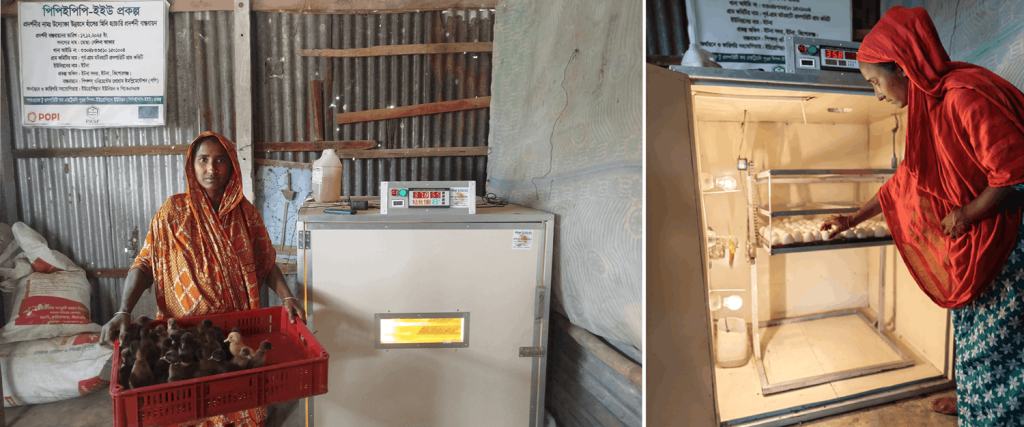
Selina also had a growing interest in establishing a hatchery in her house. After her success in duck farming, she received a 50,000-taka grant, along with necessary technical support, from the PPEPP-EU project in 2025 to establish a mini duck hatchery. Currently, local farmers are regularly buying ducklings from Selina’s duck hatchery, which earns her an additional average monthly income of 15,000 to 20,000 taka. With Selina and other farmers’ initiatives to establish duck hatcheries, local farmers’ costs for ducklings have decreased, and duckling mortality has also declined.
Selina and Sohrab have four children. Currently, two of them study at a madrasa and the other two attend school. Selina is also taking regular treatment for her osteoporosis disease, which costs around BDT 20,000 per year. Recently, Selina purchased 20 decimals of land for 500,000 taka, using earnings from her duck farm and hatchery. The income from the duck farm and hatchery has not only improved Selina’s family’s financial solvency but also enhanced their standard of living. Both their savings and assets have increased and they can now occasionally help their relatives if needed.
TESTIMONY
Happy with her progress, Selina shared with a smiling face, ‘I am receiving a lot of orders and often pre-orders for ducklings. If I had the capacity, I believe I could sell 10,000 ducklings a month. Once the rate of my duck hatching eggs increases, I want to expand my farm and hatchery and become a large-scale duck farmer in my community.’