


THE CONTEXT
Shahjahan Hossain (36) lives in a cluster village in Purbo Chhatnai Union of Dimla Upazila, Nilphamari. After completing his education, he remained unemployed for several years. His father, Ramjan Ali (63), worked as a day labourer, earning BDT 350–450 per day to support the family. Like many parents, Ramjan dreamed that his son would secure a respectable job and improve the family’s living conditions. However, despite completing his studies, Shahjahan struggled to find employment.
CHALLENGES
As Ramjan grew older, supporting the family through manual labour became increasingly difficult. Following his father’s death in 2018, the responsibility of supporting the family fell entirely on Shahjahan’s shoulders. With no alternative source of income, he began working as a day labourer on other people’s farms, earning BDT 400–500 per day. While work was available during peak agricultural seasons, employment opportunities were scarce during the off-season, often forcing him to travel outside the district to find work.
Despite these challenges, Shahjahan always aspired to do something different. He dreamed of becoming a successful entrepreneur and gradually saved small amounts of money to pursue that goal. Living near the Teesta River, he observed that most people in the area depended on agriculture, yet there were very few specialised nurseries serving local farmers. Inspired by videos and success stories he found on Facebook and YouTube, Shahjahan became interested in nursery management and entrepreneurship.
In 2022, he started a small nursery business. However, due to limited technical knowledge and experience, the venture generated little profit. Even so, he refused to give up on his dream.
TRAINING
After joining the PPEPP-EU project in 2021, Shahjahan’s wife, Maisha Begum, discussed her husband’s employment situation with the PPEPP-EU project’s officers and explored possible opportunities for him.
Recognising Shahjahan’s interest in nursery entrepreneurship, the project facilitated his participation in a month-long training course on Nursery Establishment and Management through the Department of Youth Development in Dimla Upazila in 2023. The training equipped him with practical knowledge and modern techniques necessary for running a successful nursery business.
PROJECT INTERVENTION
Upon completing the training, Shahjahan received a BDT 40,000 loan from the PPEPP-EU project to restart his nursery business. The project also linked him with the Dimla Upazila Agriculture Office and the Department of Agricultural Extension (DAE).
Through these linkages, Shahjahan obtained an official nursery registration certificate from the Department of Agricultural Extension, enabling him to operate his business on a larger scale.
In 2024, he received an additional grant of BDT 20,000 from the PPEPP-EU project to establish a specialised nursery. Combining the project grant, loan support, and technical assistance from agricultural extension officers, Shahjahan significantly expanded his enterprise.
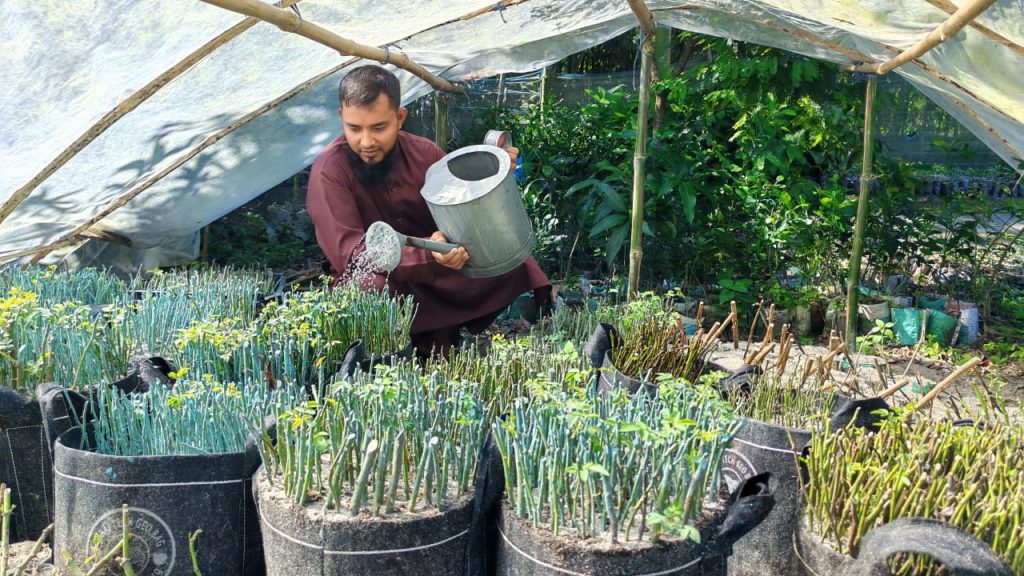
He leased 84 decimals of land for five years and transformed it into a specialised nursery. Today, his nursery employs three workers.
Beyond commercial seedling production, Shahjahan supplies saplings and agricultural inputs for Family Nutrition Garden demonstration plots under the Department of Agricultural Extension. He also promotes and sells his products through agricultural fairs at both district and upazila levels.
In addition, Shahjahan has diversified his business by producing Tricho-compost and has been selected by the Nilphamari District Agriculture Office for training on Vegetable Seedling Production in the Greenhouse.
RESULTS
Shahjahan’s nursery business has grown steadily over the years. In 2023, he earned BDT 84,000 from the nursery. His income increased to BDT 166,000 in 2024. Currently, he earns approximately BDT 40,000–50,000 per month from his nursery enterprise, providing financial stability for his family and creating employment opportunities for others in the community.
DETERMINANTS OF SUCCESS
Several factors contributed to Shahjahan’s success. The project’s linkage with the Upazila Agriculture Office and the DAE enabled him to access technical support, registration services, and market opportunities. Proper utilisation of loan assistance, the specialised nursery grant, and professional training from the Department of Youth Development helped him adopt modern nursery management techniques.
Most importantly, Shahjahan’s determination to become a successful entrepreneur, combined with continuous guidance from project technical officers, enabled him to transform challenges into opportunities and build a thriving business.
TESTIMONY
Looking ahead, Shahjahan remains committed to expanding his contribution to local agriculture. “My wife and I have established a family nutrition garden to meet our household nutritional needs. In the future, I want to receive advanced training on greenhouse vegetable seedling production and play a larger role in seedling production, marketing, and agricultural development in this region,” he said.