


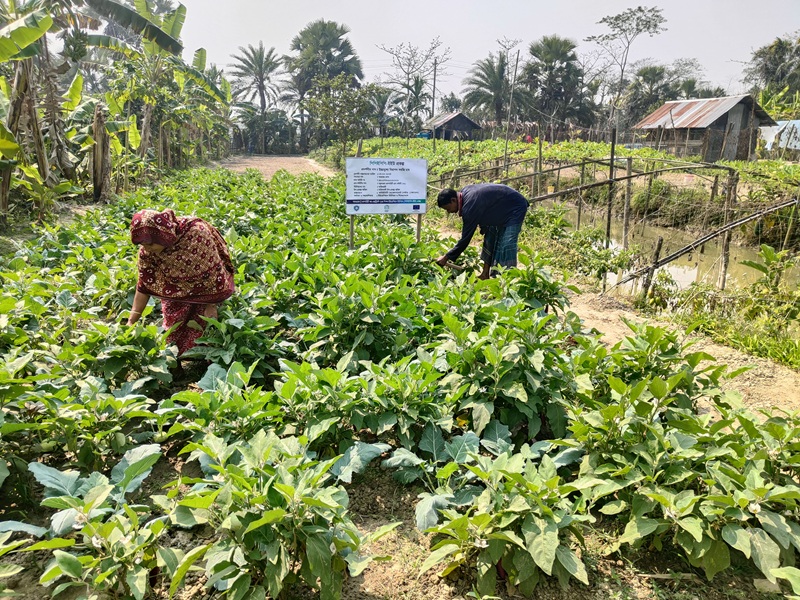
The stories of resilience and transformation emerging from PPEPP-EU members continue to inspire neighbouring communities. Shahnaz and Sobahan’s journey is a remarkable testament to courage, determination, and the power of new beginnings.
CONTEXT
Shahnaz Begum (35) is a member of CODEC, a Partner Organisation of PKSF implementing the PPEPP-EU project. Her husband, Sobahan Mia (45), suffered a severe accident in 1985 that left his right hand permanently disabled. The subsequent cost of long-term medical treatment pushed the family deep into poverty. Despite his disability, Sobahan worked as a day labourer, earning BDT 300–350 per day when work was available. However, his physical limitations often restricted his employment opportunities.
Shahnaz and Sobahan have two sons. Their younger son, Rezaul, has speech and hearing impairments. For years, the family struggled to afford three meals a day. Nutritious food was a luxury, and covering their children’s medical and educational expenses seemed nearly impossible.
CHALLENGES
Despite the potential, marginalised fish sellers operate on razor-thin margins. They are often trapped in exploitative credit cycles due to limited access to capital. Furthermore, the physical strain of carrying heavy loads on foot daily often leads to severe chronic health issues.
PROJECT INTERVENTIONS
After joining PPEPP-EU in 2019, Shahnaz began participating regularly in Prosperity Village Committee (PVC) meetings, where she was introduced to different livelihood options. Through project officers, she learned about the potential of cultivating high-value, safe vegetables.
With 27 decimals of cultivable land and prior farming experience, the couple received specialised training in vegetable cultivation and livestock rearing. Following this training, Shahnaz received a grant of BDT 15,000 from the PPEPP-EU project to kickstart her vegetable garden. To scale her operations, she eventually took four-phase loans totalling BDT 85,000 from CODEC, enabling her to expand production significantly.
With continuous technical guidance from the project, her crop yields increased substantially. This steady income allowed Shahnaz to diversify her income-generating activities. Now, along with her high-value vegetable cultivation, she owns four cows and some homestead chickens. Furthermore, through project-facilitated linkages with the Upazila Livestock Office, she ensures her animals receive regular vaccinations. Meanwhile, with the project’s support, Sobahan obtained a government-issued disability card, granting him access to essential social safety net benefits. Through project-facilitated linkage with the Upazila Livestock Office, she now ensures regular vaccinations for her cattle and poultry.
RESULTS
Their combined monthly income from vegetable and livestock farming now averages BDT 12,000–14,000. The home-grown vegetables have also improved the family’s nutritional intake.
These earnings now comfortably cover their children’s education and healthcare. With guidance from the project, the family also accesses medical services from the Union Health Complex, enhancing their overall well-being.
DETERMINANTS OF SUCCESS
Their success is driven by Shahnaz and Sobahan’s unwavering determination, mutual family support, and the improved skills achived through the PPEPP-EU project. By receiving continuous technical advice and diversifying their income streams, they have accelerated their transition out of poverty. Additionally, linkages with the Upazila Agriculture and Livestock Offices have ensured sustainable access to government extension services.
WAY FORWARD
Looking ahead, Sobahan shares their vision: “We want to establish a large-scale Farmer Hub where both women and men can find employment, and which will serve as a model for safe vegetable production in our area.”
From surviving on insufficient daily wages to building a diversified enterprise, Shahnaz and Sobahan’s journey exemplifies how targeted interventions can truly transform lives.