


Global studies revealed that persons with disabilities (PWDs) face severe barriers and discrimination as they are excluded from mainstream employment and lack access to education, healthcare and livelihood opportunities. Their financial exclusion often traps them in a vicious cycle of intergenerational poverty. However, in Bangladesh, women, children and elderly people are the most vulnerable among the PWDs.
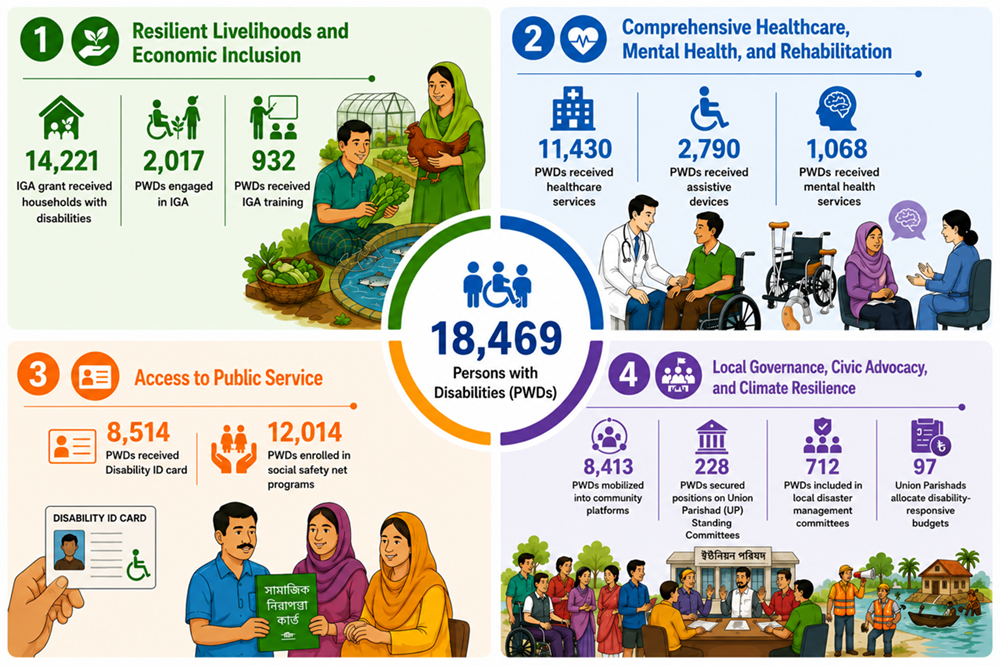
The Pathways to Prosperity for Extremely Poor People-European Union (PPEPP-EU) project prioritises its 18,469 PWD members, helping them overcome financial hardship and ensuring their mental and physical well-being. Disability Inclusion is a special focus area of the PPEPP-EU project that empowers PWDs by removing their historical barriers and marginalised conditions. The project follows the United Nations’ “twin-track” approach, integrating disability across all project components and providing disability-specific interventions and tailored support to meet their needs.
ADVANCEMENT THROUGH FINANCIAL INCLUSION AND SUITABLE LIVELIHOODS
The first step towards mainstreaming PWDs and earning them a dignified life is achieving economic independence. PPEPP-EU has successfully engaged 2,017 PWDs in income-generating activities (IGAs) according to their specific skills and abilities to ensure their financial freedom. Among them, 932 PWDs received appropriate IGA-specific skills training to unlock their full potential. Furthermore, 14,221 active family members of households having persons with disabilities received targeted grants and affordable loans to start or expand their diverse farm and off-farm IGAs.
COMPREHENSIVE HEALTH SUPPORT
The PPEPP-EU project ensures that essential health services are accessible for the PWDs, with a strong focus on nutrition, prevention, referral, and rehabilitation. Establishing strong linkages, the project has connected 11,430 PWDs to government health and rehabilitation networks, such as Community Clinics and Upazila Health Complexes, to facilitate diagnosis and access to medicine. Besides, 2672 assistive devices (e.g. hearing aids, wheelchairs) have been distributed through the project and 118 more have been distributed through local advocacy to enhance the physical mobility and communication of PWDs. The mental health camps organised by PPEPP-EU supported 1068 PWDs, of which 372 received necessary medications and 97 were successfully reintegrated into economic activities.
EMPOWERMENT, ADVOCACY AND LOCAL GOVERNANCE
To ensure that the marginalised, extremely poor people are not left behind and to provide a space to advocate for their rights, PPEPP-EU has established 82 Persons with Disability Forums, mobilising 8,413 PWDs from the Prosperity Village Committees (PVCs), a key platform for the project’s extremely poor community. In addition, 12,014 PWDs have enrolled in the government’s social safety net programs, such as the disability allowance and the stipend for students with disabilities, with assistance from PPEPP-EU in the application process. The project’s continuous support has also helped 8,514 PWDs to secure their ‘Suborno Nagorik’ card (government-provided disability ID card), almost doubling the coverage from just 53% at inception to over 96% by 2025.
PPEPP-EU’s local-level advocacy has secured positions for 228 PWDs in the Union Parishad (UP) Standing Committees and 712 PWDs in the local disaster management committees, ensuring they are prioritised during emergencies. In addition, PPEPP-EU’s advocacy efforts for dedicated budget allocation for disability-related initiatives have earned a significant achievement for PWDs, as 97 UPs now have a separate budget allocated for them in their fiscal planning.
The PPEPP-EU project continues to address structural barriers and to increase individual capabilities (skills, health, and confidence) to ensure lasting progress for PWDs and their family members.