
Bangladesh’s extremely poor people often fail to access their rights and various services due to a lack of a strong voice and awareness about their entitlements. To address this issue, PKSF’s PPEPP-EU project employs community mobilisation-related interventions that offer a transformative and sustainable pathway to reduce poverty and social exclusion.
With community mobilisation, the project shifts away from traditional welfare models towards a ‘Service delivery to rights’ approach that empowers marginalised communities through engaging and sensitising community people and relevant stakeholders and building resilience against economic, social, and climate shocks to ensure participant households’ access to various services, safety nets and other opportunities.
EMPOWERMENT THROUGH COMMUNITY PLATFORMS
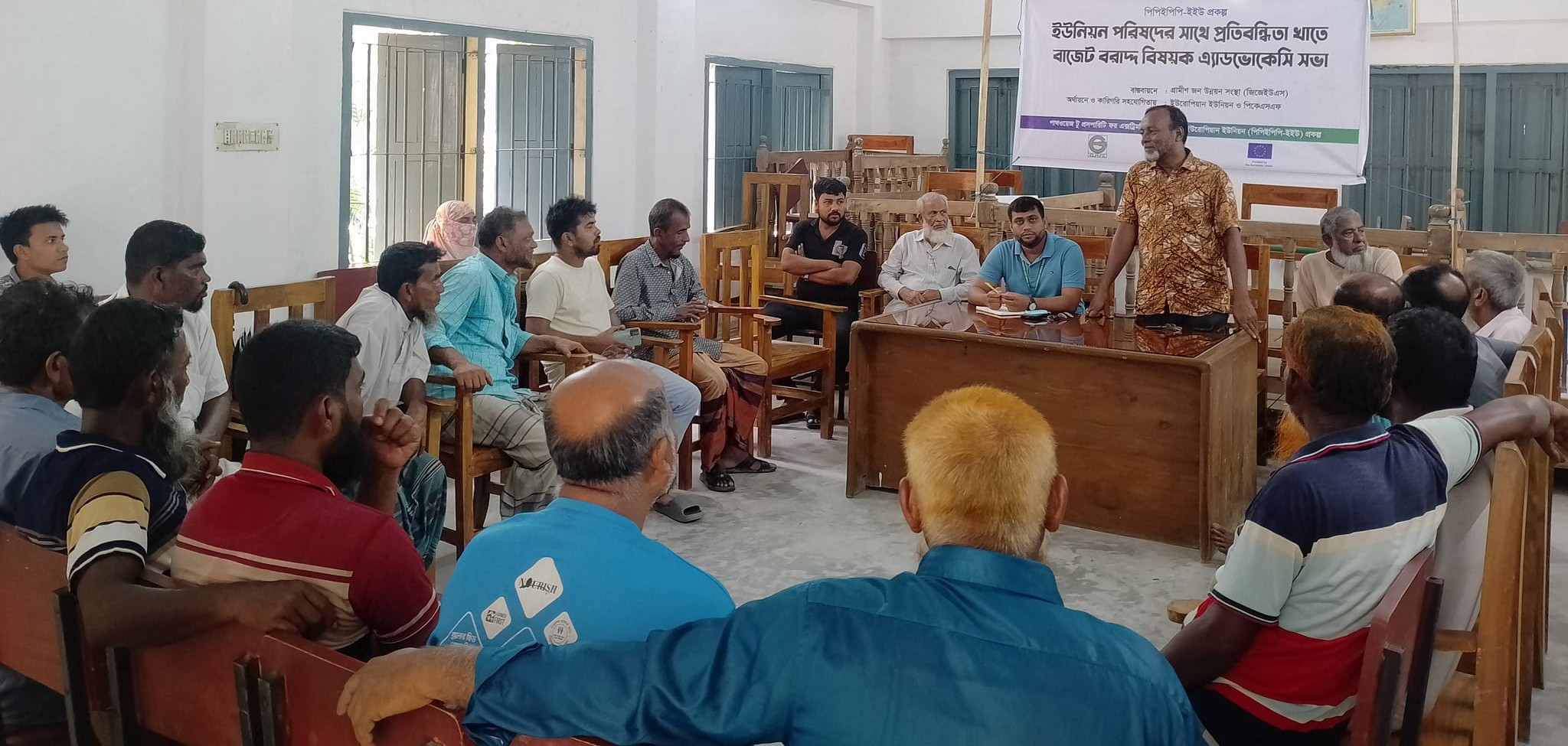
First, the project mobilises its extremely poor members through its grassroots community platforms, such as Prosperity Village Committees, Mother and Child Forums, and Persons with Disabilities Forums. These platforms serve as a centre for raising awareness of different issues, such as accessing social safety net (SSN) programs and available public services and for conducting social and behavioural change communication. In addition, these platforms play an important role in organising collective activities and advocating with government service providers.
ACCESS TO GOVERNMENT SERVICES AND LIVELIHOODS
Through the community mobilisation effort, PPEPP-EU members gained access to government technical and vocational training, crucial linkage support for skill development, access to government resources and employment. Over 18,000 members and their family members benefited from these programs, with more than half subsequently engaging in income-generating activities (IGAs). The average monthly income from these IGAs is up to 20,000, which allows households to meet their needs, invest in productive assets, and improve food security.
Community mobilisation facilitated over 169,000 government-provided services, including livestock vaccination, agricultural inputs (e.g. fertilisers, seeds), and technical assistance. More than 57,000 households received free agricultural, fisheries, and livestock services and advisory support. Households with persons with disabilities obtained disability identification cards, a government certification unlocking long-term benefits for them.
SOCIAL SAFETY NETS AND INSTITUTIONAL INCLUSION
PPEPP-EU’s awareness-raising activities and grassroots advocacy with local government institutions have enabled over 93,000 participants and their family members to access a wide range of government SSN programs and included 514 women in various Union Parishad committees. Inclusion in SSN programs such as cash allowances, food assistance, educational scholarships, employment programs, and government housing has helped stabilise household consumption, reduce vulnerability to shocks, and promote dignity and social protection.
The project’s advocacy initiatives also strengthened local health systems by engaging the community members in the management of Community Clinics and Union Health and Family Welfare Centres. Their inclusion has improved facility operations, enhanced medicine availability and transparency and increased utilisation of primary healthcare, contributing to better health outcomes and reduced out-of-pocket expenses.
DISASTER PREPAREDNESS AND CLIMATE RESILIENCE
The project works to raise awareness of disaster preparedness, response and post-disaster mitigation measures and to integrate its members into local disaster management committees and the Cyclone Preparedness Programme, thereby improving the quality of planning and preparedness at the local level. To improve access to safe drinking water and reduce climate vulnerability, in climate-stressed regions, nearly 3,000 households have received rainwater harvesting tanks and over 1,600 have received tube wells through PPEPP-EU’s direct linkages with government and non-government organisations.
SOCIAL INTEGRATION AND BEHAVIOUR CHANGE
More than 3,800 individuals and their families currently participate in the Union Parishad committees as a result of the institutional and social inclusion of the extremely poor, helping to guarantee that their demands are reflected in development plans and budgets. Another 3,000 members have joined different local social committees, including market management, village development, and religious institutions, resulting in their increased social acceptance and empowerment, particularly for women. Furthermore, the distribution of behaviour change communication materials, awareness sessions, and street dramas has effectively increased community awareness of critical issues such as child marriage, disability rights, SSNs, and health.
CONCLUSION
Community mobilisation efforts have a far-reaching influence, helping underprivileged populations to access services, engage in governance, and build resilience. The PPEPP-EU project provides a scalable and durable poverty eradication paradigm by institutionalising access to government systems, strengthening livelihoods, and promoting social inclusion. The long-lasting connections formed between communities and institutions suggest that the gains will outlast the project.