


THE CONTEXT
Rajia Khanam (33) is a PPEPP-EU member from Doiboggohati Union in Morelganj Upazila, Bagerhat. Her husband, Md. Alam Shekh, a fishing gear maker and an agricultural day labourer, is the sole breadwinner for their five-member family, which includes two daughters, aged 13 and 6, and a nine-month-old son. Alam used to feed his family on whatever little he earned, but he never considered expanding his income-generating activities (IGAs) or engaging in multiple IGAs to increase his income.
Primarily living on seasonal day labour, Alam began making fishing gear about 10 years ago after learning the skill from one of his cousins. Subsequently, his wife, Rajia, learned the skill from Alam and began helping him make fishing gear at home.
CHALLENGES
Unfortunately, the couple had long struggled to raise sufficient capital to scale up their fishing gear business. They always felt short of the capital needed to buy enough raw materials and hire more workers to increase production to meet demand. Despite their combined efforts, they could hardly earn enough to meet their household needs. Before the PPEPP-EU project support, they used to sell around BDT 50-60 thousand per month and make a mere profit of around BDT 5000. They were also missing out on large orders from wholesalers or local buyers because they could not establish strong links with them.
PROJECT INTERVENTION
In 2023, Rajia received a BDT 20,000 grant from PPEPP-EU to purchase additional materials to expand their fishing gear production. With the project’s support, the couple also established a sustained connection with local and distant buyers and increased their sales. As they began receiving more orders from buyers, they requested loans from project officials to expand their business further.
Subsequently, Rajia took multiple loans in four phases over the next two years to increase raw material purchases and the number of workers, thereby expanding fishing gear production. She gradually increased the loan amount, indicating the couple’s enhanced borrowing capacity and their business growth. At present, Rajia is continuing her instalments on a BDT 200,000 loan she took last season for business expansion.
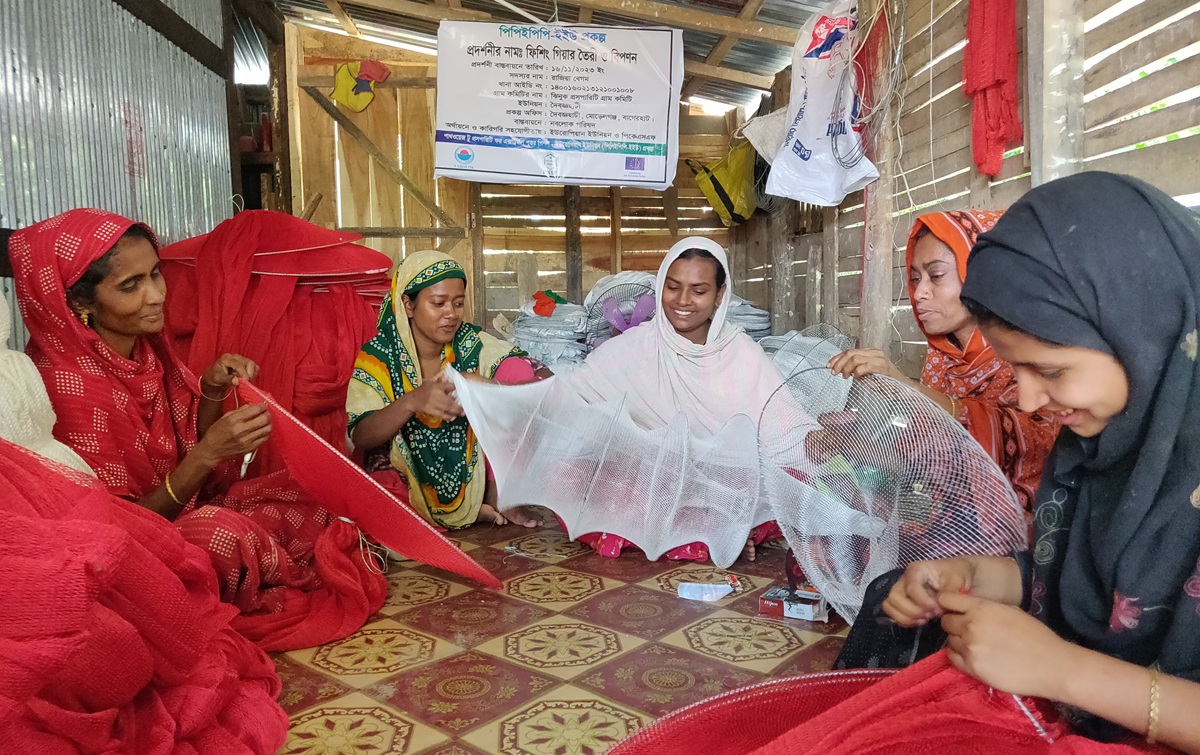
Over time, 100 women now work in their fishing gear business, earning at least 12,000 BDT per month. These women collect raw materials from Rajia and make the products at home. Once they finish making the products, Alam collects them in his van directly from their homes. After the collection, Alam and Rajia finally prepare all the fishing gear for delivery to the buyers.
The couple has moved to a new home to accommodate their production expansion and to provide a more convenient place for buyers to collect their orders. Buyers from neighbouring districts such as Khulna, Bagerhat, Pirojpur and Barishal place orders over the phone and collect their products directly from Rajia’s home.
RESULTS
The couple currently have a 500-piece fishing gear order in hand, worth around BDT 200,000. They produce six types of fishing gear in various sizes, and the prices range from BDT 250 to BDT 4000, depending on the quality and size. They make a profit of 20-25 thousand BDT per month by selling 3-3.5 thousand units of fishing gear.
Rajia now has two cows and 10 ducks, which she bought using her household savings. They also have a pond of 33 decimals, which they use for a variety of fish culture throughout the year and often sell surplus fish in the local market after consumption.
TESTIMONY
For half the year, their fishing gear business does very well, but during the lean period, Alam works as a daily-wage labourer. Rajia said, “If we had more capital, we could make more fishing gear in advance and deliver the products as soon as we get an order.” So, Rajia and Alam plan to expand their production by taking an even bigger loan after repaying the current instalments. “I believe selling products worth one crore is also possible because we get a lot of orders from buyers, but we cannot increase our production to meet their demand. If we get more capital, we can have better sales”, Alam shares with firm confidence.