
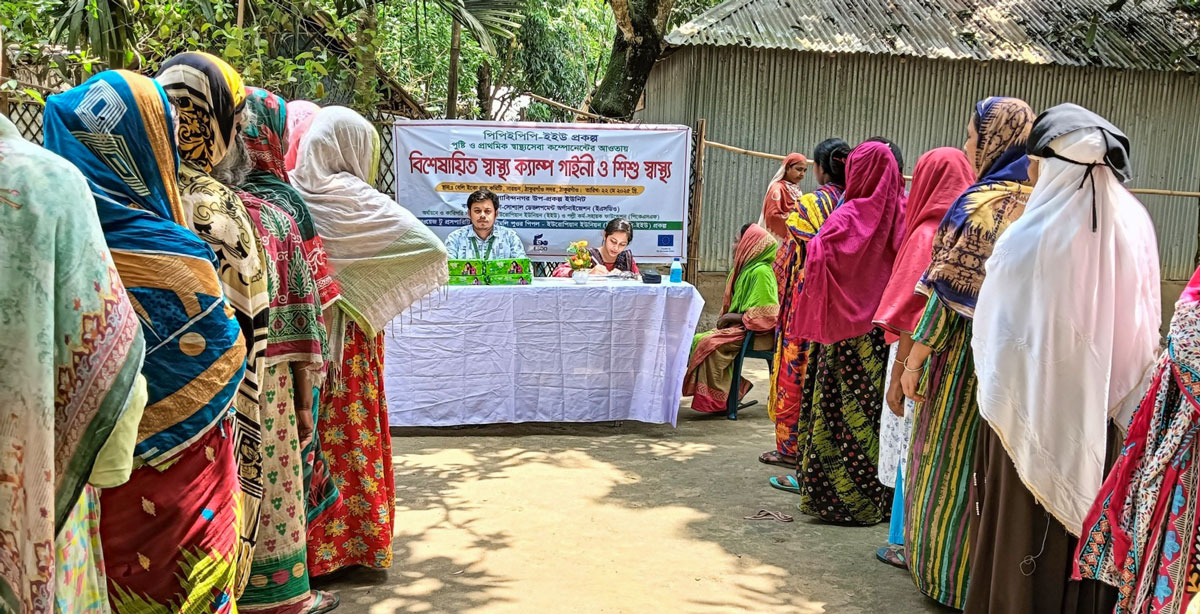
In some of Bangladesh’s most remote and underserved regions, primary healthcare is often inaccessible to many. For extremely poor households, the lack of nearby health service facilities, trained doctors or essential medicines can turn minor illnesses into serious health threats. To address this challenge, the PPEPP-EU project provides specialised healthcare to the poorest through dedicated health camps focusing on child health, gynaecology, adolescent girls, and eye and mental health.
Across the project’s 145 operational unions, these camps are organised by its implementing partner organisations with support from specialised doctors and PPEPP-EU’s trained Community Nutrition and Health Promoters (CNHPs). Together, they deliver life-saving primary health services to the doorsteps of thousands of families.
Supporting mothers and children
Special child health and gynaecology camps provide essential antenatal and postnatal care, reproductive healthcare, counselling, and medications to pregnant and lactating women, as well as children under five. These camps play a vital role in combating intergenerational undernutrition by addressing the “1,000 golden days” and reducing low birth weight and acute and chronic undernutrition in children.
Saleha Begum from Khulna’s Mongla Upazila shared, “This time, I expect to give birth to a healthy baby free from complications,” after receiving gynaecological care and nutrition guidance during one of the health camps. To date, over 71,000 children and mothers have benefited from these health camps.
Meeting the needs of adolescent girls
Adolescent girls in rural Bangladesh often face menstrual problems, gynaecological issues, and a lack of hygiene products. PPEPP-EU’s specialised adolescent health camps create a safe and confidential space for these girls to seek help.
A fifteen-year-old daughter of a PPEPP-EU member from Patuakhali district’s Galachipa Upazila, who struggled with irregular menstruation and unusual discharge, shared after attending a similar health camp, “The doctor was very kind to hear out my issues. She offered kind advice, and I feel much better now.”
So far, around 26,000 adolescent girls attending these camps have received treatment, referral support, and free hygiene items, including sanitary pads, soap, and shampoo.
Fostering mental wellness for the most vulnerable
Mental health services are the most neglected in rural Bangladesh. PPEPP-EU is addressing this gap by organising specialised mental health camps led by psychiatrists. Patients receive consultations, medicines, and close follow-up from CNHPs to support their long-term recovery.
Amena from Bhola, who was severely affected by mental illness, regained stability after consulting with a mental health professional during the camp. “Now I live a happy life with my husband and family,” she said.
So far, over 153,000 extremely poor people have received treatment, referrals, and free medicines through the PPEPP-EU project’s 2,244 health camps. These camps continue to provide essential health care in areas where community clinics are unreachable or too distant, ensuring that no family is left behind.