
CONTEXT
Women in Bangladesh have made remarkable progress in creating opportunities for themselves. For example, girls have outnumbered boys in school enrollments at both the primary and secondary levels, women have become members of local government bodies and a large number of formal-sector jobs have opened for them.
CHALLENGES
Despite these achievements, women in general and especially in extremely poor settings struggle to secure employment, claim their rights in family and society, face discrimination, exclusion and injustice and have negligible influence in the decision-making process in their households and communities.
SOCIO-ECONOMIC EMPOWERMENT
To involve extremely poor women in productive, income-generating activities for economic empowerment and to reduce gender disparity, the PPEPP-EU project is working through a range of support, including resilient livelihoods, financial inclusion, nutrition and primary healthcare, and access to public services. The project adopts a Gender Transformative approach to shift power dynamics and social norms within households and the broader community.
ECONOMIC TRANSFORMATION
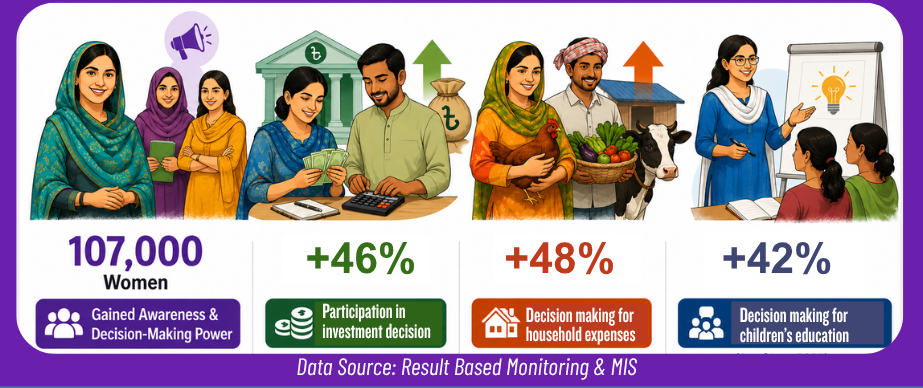
PPEPP-EU works to strengthen women’s economic positions by supporting women-managed income-generating activities such as livestock rearing, vegetable cultivation and tailoring. The project makes a conscious effort to ensure that women have full access to the loans they take out or the right to decide how best to use the money. A recent results-based monitoring (RBM) study conducted in 2025 suggests that women’s participation in investment decisions increased 46% and decision-making for household expenses increased by 48%.
Women members also receive IGA training to develop their technical skills, become micro-entrepreneurs and gain their desired financial freedom. Nearly 92% of targeted women have received livelihood training.
SOCIAL TRANSFORMATION
PPEPP-EU addresses the root causes of inequality in household settings and extends support for gender equality to women members by mobilising them through various social platforms and through awareness campaigns to increase women’s participation in decision-making at the household and community levels. The project utilises Prosperity Village Committees (PVCs), in which women members are encouraged to take leadership roles in public forums, and 80% of them reported awareness of critical issues, including property rights and domestic violence prevention. More than 107,000 women have benefited from awareness and counselling on leadership, negotiation, and decision-making, greatly enhancing their confidence and social standing. In addition, women’s decision-making regarding children’s education increased by 42%.
The Couples’ Forum is another platform where women members, along with their male counterparts, attend issue-based sensitisation sessions that promote joint decision-making and encourage men to participate in unpaid care work and domestic chores. Complementing this is the “Exemplary Father” campaign, which honours men who treat sons and daughters equally and share household responsibilities.
Thus, PPEPP-EU’s other activities involving men and women help sensitise male members (father, husband, son) through Social Behaviour Change Communication on women’s empowerment and rights, and dismantle patriarchal resistance within the family. RBM findings indicate that overall empowerment levels across project households surged from 24% in 2021 to 55% by 2025, surpassing the initial target of 48%.
CONCLUSION
A transformative mindset has taken root within the family through the integration of economic support and social and behavioural change, ensuring that women are partners and leaders in development. The success of PPEPP-EU’s empowered women is also recognised nationally, as 17 women members earned the Joyeeta Award and another 13 members received the Indomitable Woman Award (Odommo Nari Puroshkar) from the government of Bangladesh during the project period.