

THE CONTEXT
The Resilient Livelihood component of the PPEPP-EU project works to connect extremely poor people with economic growth and set them on a sustained pathway out of poverty. This is a key component designed to boost the incomes of extremely poor people (primarily targeting women) by engaging them in a range of income-generating activities (IGAs). The livelihood interventions involve extremely poor households with different farm (crop, fisheries and livestock activities) and off-farm-based IGAs (vocational and others) by ensuring financial services (appropriate loans and grants), capacity building support, technical services, enterprise development and value chain interventions, market linkages, linkage with public and private service providers and by building their resilience against climate and other shocks.
The PPEPP-EU project, funded by the European Union, contributes to poverty reduction and strengthens resilient livelihoods in 145 climatically vulnerable Unions across 12 districts in the north-western Manga areas, south-western climate-hazard areas, haor regions, and selected ethnic minority areas of Bangladesh.
ESTABLISHING THE LIVELIHOOD ACTIVITIES
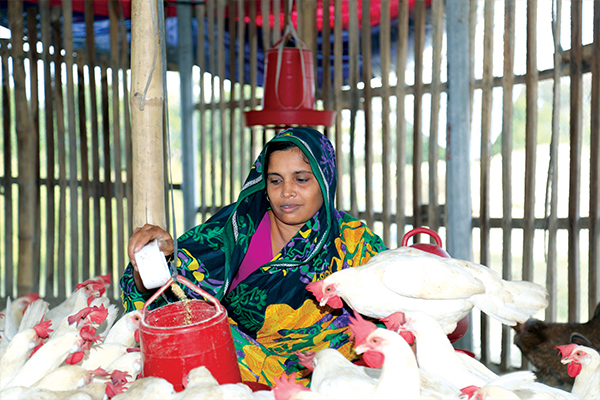
PPEPP-EU’s livelihood component has implemented 1,08,009 livestock related IGAs, 88,168 crop cultivation IGAs, 54,142 fisheries-based IGAs and 21,916 non-farm IGAs, until February 2026. Some of the members’ IGAs are already showing promises of flourishing into micro-enterprises with value-chain interventions from the project. Members engaged in IGAs have received intensive training and the project provides technical support and services through its field-level staff to facilitate the appropriate implementation of these IGAs for participants.
PPEPP-EU provides grants and appropriate loan services to its members to establish livelihood activities and support livelihood diversification for multiple income opportunities, ensuring sustained income generation. The PPEPP-EU members have so far borrowed BDT 28,346.50 million with an average loan size of BDT 32,266. The diversified loan portfolio enabled beneficiaries to pursue livelihood activities suited to their capacity and stage of economic development.
GROWING IMPACT ON PPEPP-EU MEMBERS
The livelihood component has significantly strengthened household resilience by diversifying income sources. The recent Results-based Monitoring (RBM) study found that the share of households maintaining two or more income sources has nearly doubled, from 45.7% to 83.5%. The project members are now able to gain nearly full-time employment (around 40 hours/week) during the normal period. The RBM data show that the number of days of employment increased from 20 to 25 days (in the normal period) and from 12 to 19 days (in the lean period) from 2021 to 2025.
The per capita monthly income data reveal a positive trend, indicating improved household financial capacity. The project’s mid-term evaluation findings reveal a positive trend, with overall income rising from BDT 2,273 at baseline to BDT 3,853 at mid-line, reflecting the collective impact of the intervention on household financial well-being across all regions.
According to the PPEPP-EU project’s mid-term evaluation findings, the average monthly expenditure of the participant households has increased from BDT 9,106 at baseline to BDT 13,638. The substantial growth in expenditure suggests improved economic well-being and increased access to goods and services. The average financial asset value of the members has also increased from BDT 4,894 in the baseline study to BDT 9,978.
The PPEPP-EU Project has had a notable positive impact on household resilience to climate-related and other shocks. At baseline, only 20% of households were in the treatment group and by midline, this increased to 40%. Although a majority of households (72%) were already aware of climate shocks at baseline, this awareness has increased to 89%, indicating a larger differential gain for the participants’ group.
Overall, the percentage of extremely poor households below the $2.15/day/per capita poverty line fell from 62.72% at baseline to 22.25% at midline.