
THE CONTEXT
Khalilur Rahman (40) lives with his wife, Muslima Begum (31), and their two children- a son and a daughter- in the remote village of Kaikhali Union in Shyamnagar Upazila, Satkhira. Khalil once worked for a non-governmental organisation (NGO) and enjoyed a stable livelihood. However, his life took a dramatic turn when he suffered a severe injury while playing in a village volleyball match. The accident left his right hand permanently paralysed and significantly weakened his right leg. What followed was a long and costly period of surgeries, therapy, and medication. Despite his efforts to recover, he eventually lost his job and faced an uncertain future.
CHALLENGES
Following Khalil’s disability, the family struggled to maintain a steady source of income. Medical expenses placed a significant burden on their household, while employment opportunities became increasingly limited due to his physical condition. With two children to support and no reliable source of income, even meeting daily household expenses became difficult.
PROJECT INTERVENTION
As a household affected by disability, Muslima became a PPEPP-EU member, followed by Khalil’s inclusion in the Persons with Disabilities Forum, a social platform under the project. Project officers constantly guided them on suitable livelihood opportunities and encouraged them to explore self-employment opportunities that could be managed despite Khalil’s physical limitations.
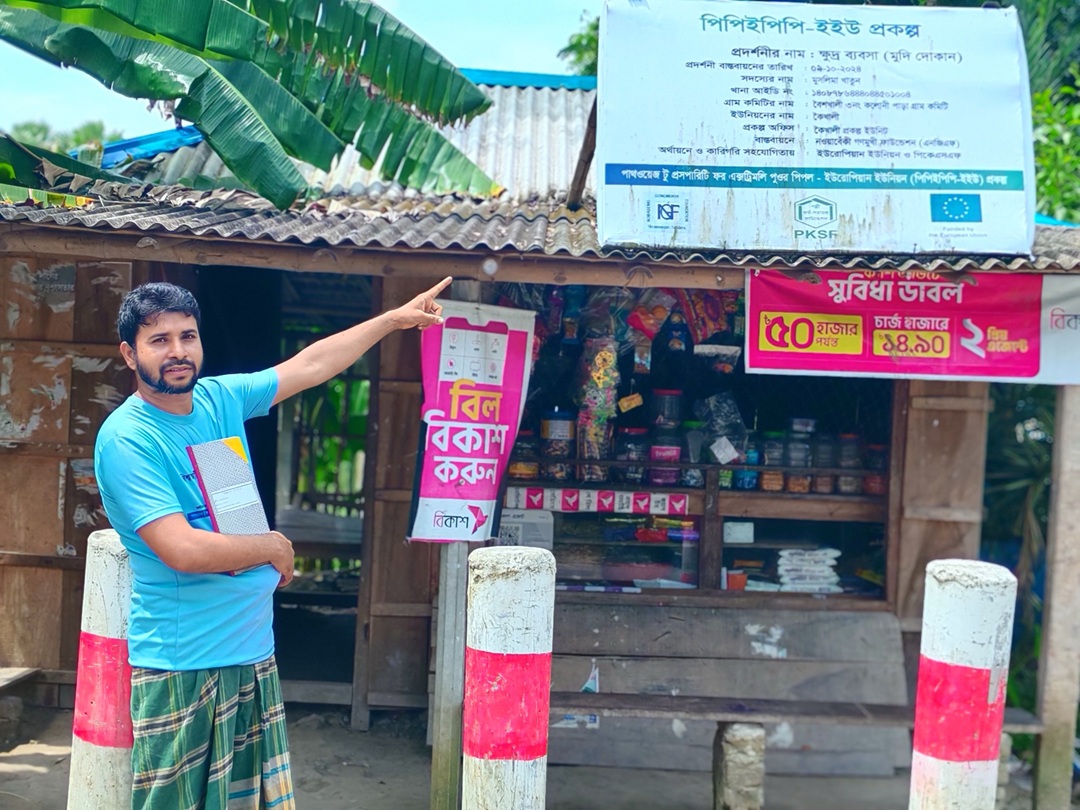
In 2024, Muslima and Khalil received a BDT 25,000 grant from the PPEPP-EU project to establish a small grocery business. To strengthen the investment and purchase additional stock and essential items for the shop, they also took a BDT 10,000 loan from NGF, an implementing partner of PPEPP-EU.
With this support, Khalil and Muslima established a grocery store in their community. While Khalil manages customer service and daily operations, Muslima plays an equally important role by maintaining accounts, managing inventory and assisting with purchasing and transporting goods for the store.
But they did not stop here and began rearing poultry and cultivating seasonal vegetables on their homestead, with seeds provided by the project. This initiative improved their household nutrition while generating additional income from surplus vegetable sales.
Encouraged by their consistent success, Khalil and Muslima took another step towards expanding their livelihood. With technical guidance from project officers, they leased 33 decimals of land and invested BDT 18,000 in cultivating watermelon as a climate-resilient crop. The PPEPP-EU project further supported them by facilitating market linkages with buyers, helping ensure profitable sales.
Beyond financial assistance, the PPEPP-EU project also facilitated Khalil’s inclusion in the government’s social safety net programme as a person with disability, as he now receives a disability allowance of BDT 2,550 every quarter.
RESULTS
The grocery store generates monthly sales of approximately BDT 20,000-25,000, resulting in a net profit of BDT 5,000-7,000 after expenses. Their homestead vegetable production contributes significantly to their nutritional needs while providing supplementary income through sales. Their watermelon cultivation proved particularly successful, generating nearly BDT 50,000 in revenue and a profit of approximately BDT 32,000. In addition to improving the financial condition, these diversified income sources have strengthened their resilience and reduced their dependence on a single livelihood activity.
Khalil has also emerged as a community leader. He currently serves as President of the PPEPP-EU Disability Forum in his community and actively advocates for the rights and development of persons with disabilities.
TESTIMONY
Looking ahead, the couple dreams of expanding their grocery business and establishing a small cattle farm. Reflecting on their journey so far, Khalil expressed his gratitude: “This project (PPEPP-EU) did not just provide us with financial support; they gave us the courage to take new ventures and supported us by all means.”